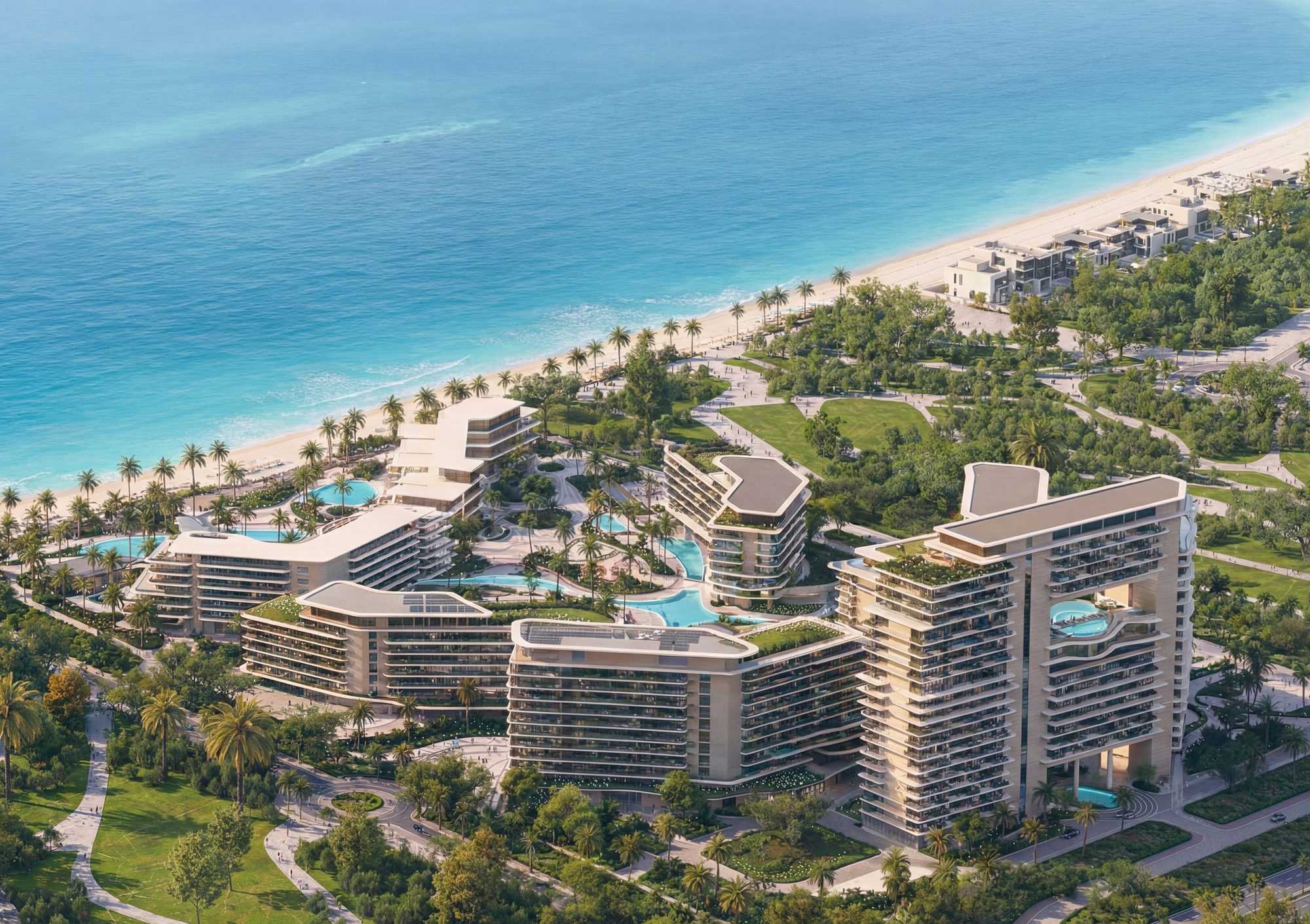
Dubai’s waterfront is far smaller than its marketing suggests. By land area, the districts that genuinely front the sea or a waterway cover about 1.3% of the emirate. Yet because they are built upward, we estimate they hold roughly 8 to 9% of its homes. This article sets out how we counted, what is solid, and what is our own working estimate.
The short answer
- Land. About 55 km² of waterfront districts, against Dubai’s total area of 4,114 km². That is about 1.3%, or about 1.7% on a generous count.
- Homes. Our working estimate is that these districts hold roughly 8 to 9% of Dubai’s housing units. This is our estimate, not an official statistic.
- Supply. Most of the waterfront land that was available has already been taken, as the sections below explain.
What we counted
We took the published areas of the main districts that sit on the sea, an island, a creek or a canal, and added them together. All figures are approximate.
| Area | Approx. km² | Basis |
|---|---|---|
| Dubai Islands | 17.0 | Nakheel |
| Palm Jebel Ali | 13.4 | Dubai Media Office |
| Dubai Creek Harbour | 6.0 | Developer figure |
| Palm Jumeirah | 5.7 | 61 million sq ft |
| Business Bay | 4.4 | Published figure |
| Dubai Maritime City | 2.3 | Published figure |
| Dubai Harbour | 1.9 | 20 million sq ft |
| Dubai Marina | 1.6 | Published figure |
| Pearl Jumeirah | 0.8 | 8.3 million sq ft |
| Jumeira Bay | 0.6 | 6.3 million sq ft |
| La Mer / Port de La Mer | 0.5 | Our estimate |
| JBR | 0.4 | Our estimate |
| Bluewaters Island | 0.2 | Our estimate |
| Total waterfront | about 55 | about 1.3% of 4,114 km² |
Business Bay and Dubai Creek Harbour are counted whole, although only part of each fronts the water, which overstates them. The three smaller beachfront areas at the end of the table are our estimates. We left out the Jumeirah and Al Sufouh seafront, the creek frontage in Deira, Bur Dubai, Al Jaddaf and Festival City, the Water Canal frontage, Al Mamzar and The World Islands, because we found no reliable areas for them. We think they could add about 10 to 15 km², which would lift the total to about 70 km², or 1.7%. That addition is our guess.
From 1 to 2% of the land to 8 to 9% of the homes
Waterfront is built upward. A tower or a dense low-rise block puts far more homes on a hectare of coastline than a mainland villa street does. ValuStrat puts Dubai’s housing stock at about 977,000 units in mid-2026, and other estimates run from about 900,000 to 935,000. Our working estimate is that the projects and buildings on the waterfront districts above come to roughly 8 to 9% of the total available units, which would be about 78,000 to 88,000 homes on a base of 977,000.
The conclusion that matters is the direction: a very small share of the land carries a much larger share of the homes.
Why the supply is closing
- Palm Jumeirah has effectively completed its available plot supply.
- JBR and Dubai Marina are built out.
- What remains is mainly Dubai Maritime City, Dubai Islands and Palm Jebel Ali.
Dubai Islands is made up of five islands, A to E, and is the largest pool still open. In our reading of the market, Island A is the most mixed, with many first-time developers stepping in, which makes it more crowded. Island B is limited to Nakheel, Ellington (The Meriva Collection) and Beyond, with a new launch. Island E began with Nakheel villas, which were launched recently. Palm Jebel Ali is Nakheel’s. These are our observations, not a published list. For a Dubai Islands example, see Ramada Residences.
What price history shows
Scarcity shows up in prices, but it should be read with care.
- Palm Jumeirah. ValuStrat reports that Palm Jumeirah villa values have roughly tripled since the pandemic. Another analysis has Palm apartments rising from about AED 1,200 per square foot in Q1 2020 to about AED 3,300 in Q1 2026. Taken together, that is roughly 2 to 3 times since 2020.
- Waterfront communities. Springfield Properties reports that waterfront villa and apartment communities grew by 15 to 30% in 2025, ahead of broader benchmarks.
- The wider market. Dubai villa values as a whole rose about 206% since 2020, according to ValuStrat. Waterfront is not the only winner. Supply-constrained communities led, and waterfront is the clearest example.
- Sources differ. One analysis puts Palm Jumeirah growth at about 5% a year over five years.
Past growth is not a promise. Prices can fall as well as rise, and every project should be tested against comparable sales.
How to read “waterfront” in a listing
- True beachfront. Direct sea frontage on a natural or island beach. This is a very small slice of the market.
- Man-made waterfront. Marina, canal, creek or lagoon frontage. It adds a lot of inventory, but counting it inflates the number.
- Sea or water view. A view from a higher floor. It is often marketed as “waterfront”, but it is not.
Ask which of the three a listing is, how far the entrance is from the water, and whether the view is protected from future building.
Beyond Dubai
The same scarcity logic is why we also look along the coast outside Dubai. Y Views at BAYN Ghantoot, on the Abu Dhabi side of the border, is a gated beach and canal-front villa cluster by ORA, with a 40/60 payment plan on selected villas.
Sources: ValuStrat (mid-2026 housing stock and villa values), Khaleej Times (end-2025 stock and Springfield Properties waterfront growth), and developer and published district areas. The land-area calculation and the 8 to 9% share of homes are Lux Queina estimates.